

JSGS doctoral student on female, family and foreign-born experiences in the Canadian labour market
PhD candidate, Damilola Afolabi, explores how gender, family status, and immigrant background intersect in Canada’s labour market, forming the “triple negatives.”
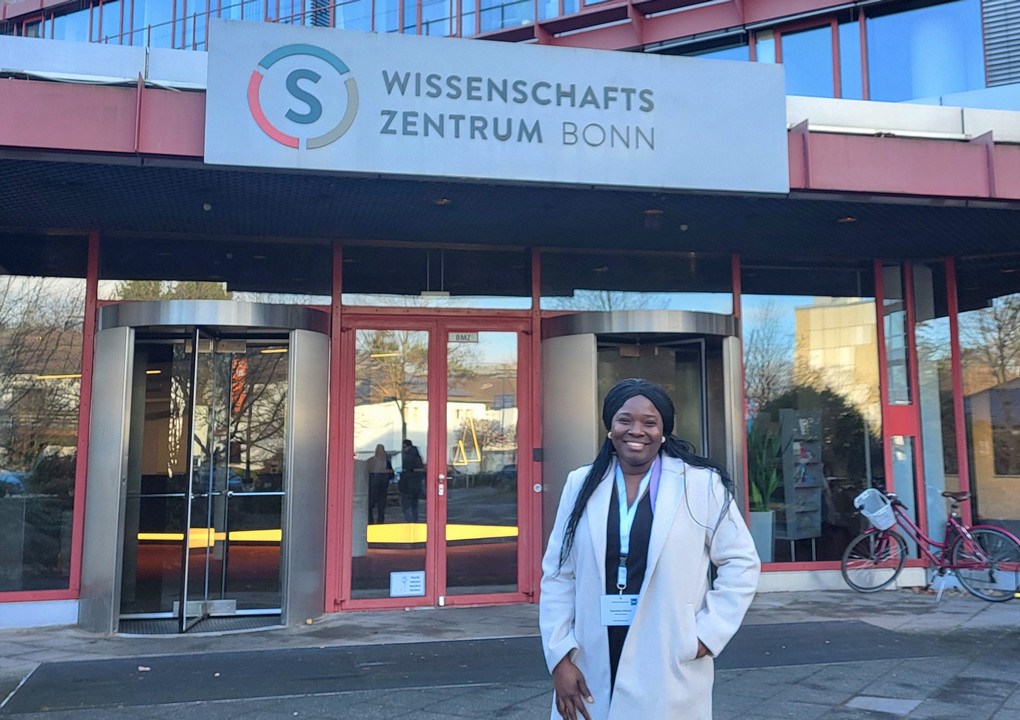
By Sebastian Eger for JSGSLast Fall, Damilola Afolabi, a PhD candidate at the Johnson Shoyama Graduate School of Public Policy (JSGS), University of Regina campus, under Professors Jim Farney and Haizhen Mou’s supervision, attended the Annual Global Labor Organization (GLO) conference in Bonn, Germany.
Her purpose was clear: to strengthen the scholarly and policy foundations of her dissertation on the triple negatives for immigrant mothers in Canada.
Afolabi’s research examines how the combined effects of gender, immigration status, and caregiving responsibilities intersect to create a “triple disadvantage”, shaping unequal economic outcomes and what this means for Canadian labour market equity.
Grounded in an empirical and intersectional approach, Afolabi’s doctoral work is closely informed by her lived experience as a Black immigrant Canadian and a mother.
“My research questions stem directly from observing how highly educated immigrant women often remain economically marginalized despite strong human capital,” she said. “Immigrant families continue to face social and structural barriers that impact their long-term opportunities in Canada.”
A major contribution of the conference to Afolabi’s PhD progress was the opportunity to present and position her study within an international research community focused on labour economics.
“I presented my research titled, “Is there a Motherhood Penalty for Immigrant Mothers in the Canadian Labour Market compared to Immigrant Non-Mothers,” where I explore the impact of children on the earnings of immigrant mothers in Canada, and how the motherhood penalty varies by immigration category, an area that has received less attention from other researchers.”
Afolabi’s prior experience working in policy and regulatory development at provincial and federal government levels has also played a role in strengthening her approach to research.
“Having seen the impact of this work to evidence-based labour market and social policy reform on immigration, employment, and family policies, I no longer view my research simply as an academic exercise or a class essay to be submitted for grades,’ she said. “I see it as work that can contribute toward significant policy change.”
Afolabi used the conference as a strategic opportunity to advance her research, intentionally selecting sessions on gender, migration, and labour-market integration that aligned with her dissertation’s fundamental themes: income inequality, gendered immigration, and work-life dynamics.
Sharing her dissertation in this setting allowed her to test the framing, relevance, and interpretation of her work in broader comparative and policy-oriented research.
“The sessions helped situate my work within broader international debates about work-family balance and gender-based inequality,” she said. “Factors including affordable childcare services, parental leave policies, and labour laws significantly shape outcomes, underscoring the need to interpret Canadian findings within their broader policy framework.”
The conference also facilitated meaningful scholarly exchange. “I had the opportunity to exchange ideas and engage with researchers studying similar issues, including those whose work I cited in my research,” Afolabi said.
While the conference was valuable for advancing her dissertation, some of Afolabi’s favourite moments were outside the formal program and included spending time with fellow participants at the Bonn Christmas market.
“The evening offered a meaningful space and balanced the intensive academic discussion along with some delightful potato pancakes,” she recalled.