

Saskatchewan Potash at a Crossroads: $12 Billion of Lost Revenue and BHP’s New Mine
In 2027, global mining giant BHP will begin production in Saskatchewan at one of the world’s largest potash mines. The Jansen mine will have a dramatic impact on the potash market and adds to the issue of whether the Saskatchewan government gets a fair return in royalties from potash development for the people of the province.
By Erin Weir, Former MP and Consulting Economist, Silo StrategyIntroduction
Download the JSGS Policy Paper
Download the Disussion Questions
The world’s largest mining company, BHP, will open one of the world’s largest potash mines at Jansen in 2027. The Government of Saskatchewan has stated, “the Jansen mine will generate tens of billions of dollars in taxes and royalties.”1
Since natural resources belong to the people of Saskatchewan, a new mine should generate substantial revenues to help pay for healthcare, education and other important public services.
However, the provincial government’s sweeping royalty and tax concessions mean that BHP will contribute very little. To the extent that Jansen undercuts potash prices for existing mines, it could lower provincial revenues.
The prospect of significantly expanded potash production reducing provincial revenues should motivate a long overdue review of Saskatchewan’s royalties and taxes, which the following analysis suggests have forgone nearly $12 billion of potash revenue over the past decade.
Saskatchewan’s Global Position
BHP came because Saskatchewan has the world’s largest and richest potash reserves. The province provides about one-third of global production. Russia and Belarus mine another third. The final third comes from China and a handful of smaller producers.2
Uralkali monopolizes Russia’s potash industry. Belaruskali, a state-owned firm, controls potash mining in Belarus. Sinochem and other firms with Chinese state-ownership dominate potash mining in China and potash development in Laos.
Therefore, none of the other main potash jurisdictions are open to western corporations. Saskatchewan has no major competitors for such investment. Even after the provincial government opposed BHP’s 2010 offer to buy the Potash Corporation of Saskatchewan (PCS),3 BHP still came back to invest billions.
PCS merged with Agrium to become Nutrien and permanently closed its New Brunswick potash mine in 2018.4 Mosaic sold off its potash mines in Brazil and New Mexico in 2025.5 Saskatchewan will be the sole source of potash for Nutrien, Mosaic and BHP.
The province is well positioned to supply potash to the American corn belt at prices above the offshore market.6 A record US corn harvest in 2025 bolstered demand for this fertilizer.7
Despite speculation about potential tariffs, Canadian potash continues to enjoy tariff-free access to the US. Mosaic’s recent decision to sell off its American mine signals confidence about exporting Saskatchewan potash south of the border.
If a tariff were imposed, much of it would be paid by American farmers rather than by Saskatchewan mines. Even after subtracting a tariff, the profits from selling a tonne of potash to the US would likely still exceed those from selling a tonne offshore.8
Profits retained by the companies accrue almost entirely to out-of-province shareholders. Mosaic, BHP and K+S are foreign corporations in which Canadians hold below 2% of shares. Nutrien is incorporated in Canada, but Americans and other foreign investors hold most of its shares.9 Overall, fewer than 3% of Canadian shareholders live in Saskatchewan.10 PCS privatization reduced Saskatchewan’s ownership stake in potash companies to “a very small fraction.”11
However, the people of Saskatchewan own the resource. Unfortunately, the province has not used its strong bargaining position to negotiate the best possible return. As former provincial finance minister Eric Cline documented in his 2024 book, Squandered: Canada’s Potash Legacy, the province has collected only a meagre share of rising potash sales and profits.12
Potash Sales
Saskatchewan’s annual potash sales jumped from about $2 billion before 2007 to about $6 billion in the 2010s, to $18 billion in 2022 and over $9 billion last year (see Figure 1). The provincial budget projects potash sales of $10 billion this year.13 While potash prices have moderated since 2022, the province’s potash sales in 2023, 2024 and 2025 were worth more than in any year before that peak.
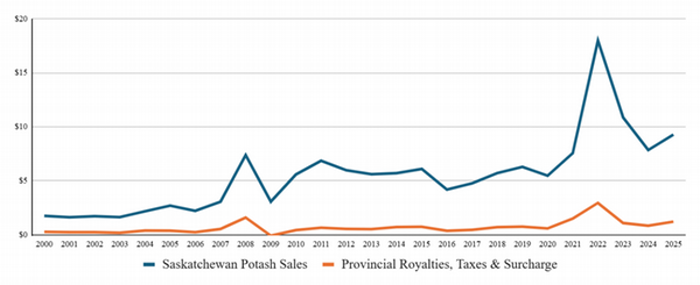
Figure 1: Saskatchewan Potash Sales and Royalties, 2000 - 2025 ($ billions)14
From 2000 to 2025, the value of Saskatchewan potash sales quintupled mostly because potash prices tripled (up by 203%).15 Since Statistics Canada’s Consumer Price Index rose by only 72% during this quarter century, potash prices surpassed inflation by 131%.16
Higher prices motivated more output – with tonnage up 76% since 2000 – and added more profit to existing production. The most obvious windfalls were in 2008 and 2022. In both years, potash prices more than doubled without any increase in output from the preceding year.
The province’s royalties, production tax and resource surcharge together typically collect no more than 15% of the value of potash sales, or under $1 billion in all but a few years.
Saskatchewan collected $1.6 billion in 2008-09. Revenue in that fiscal year’s final quarter reflected overly optimistic projections for 2009. As a result, the province refunded money to potash companies and booked negative potash revenues in 2009-10.17
Potash revenues peaked at $2.9 billion in 2022, when sales peaked at $18 billion. My previous Johnson Shoyama policy paper, Saskatchewan’s Forgone Potash Windfall, argued that the province should have collected more of the extra $10 billion added by that year’s price spike.18
The Saskatchewan Mining Association’s latest fact sheet presents 2024 data. It reports that potash companies paid $1.1 billion to their employees, $2.2 billion to local suppliers and $1.2 billion to all levels of government.19 Much of the procurement figure surely reflects out-of-province inputs resold by Saskatchewan businesses, not incomes for Saskatchewan people. The $1.2 billion includes federal corporate tax. But even adding all three figures together amounts to little more than half of the nearly $8 billion of potash sold from the province in 2024. Much of the value extracted from Saskatchewan is not being returned to the province.
Potash Profits
Rising potash prices and sales have created huge profits. In Squandered, Cline tracks growing profits from 1995 to 2022 at five companies. Each of their potash divisions consistently generated positive gross margins during every year of operation. For at least the past 30 years, no company has ever lost money operating potash mines in Saskatchewan.20
Since Nutrien was formed, it and Mosaic have controlled over 90% of the province’s potash output. Nutrien’s annual reports provide figures back to 2017. To consider a full decade of data, Table 1 combines PCS and Agrium figures for 2016, when their merger was first announced.
K+S, the province’s third potash producer since 2017, does not report Saskatchewan sales, costs or profits separately from its worldwide operations. Its solution mine at Bethune accounts for under 10% of Saskatchewan potash production.
In 2025, K+S began an expansion to double Bethune’s output.21 While welcoming the investment, Saskatchewan policymakers should seek more transparent public reporting from this growing segment of provincial potash output.
The former PCS mine in New Brunswick stopped production in 2016 and permanently closed in 2018. The company explained, “The decision to close the New Brunswick potash facility reflects Nutrien’s ability to increase potash production in Saskatchewan at a significantly lower operating and capital cost.”22 Reports from Nutrien’s potash segment exclusively reflect Saskatchewan mines: Rocanville, Allan, Lanigan, Cory and Patience Lake from PCS plus Vanscoy from Agrium.
Over the past decade, the value of potash sold from these mines doubled. Given little increase in costs, profits nearly quadrupled from half a billion US dollars in 2016 to two billion last year. Depreciation and amortization of previous investments have represented at least one-third of costs and more in the last two years. The merger and automation have held Nutrien’s cash cost of mining and transporting potash flat at about US$800 million (excluding royalties and taxes) in each of the past ten years.23
Table 1: Nutrien’s Potash Sales, Costs, Profits, Royalties & Taxes, 2016 - 2025 (US$ millions)24
Sales |
Costs |
Mine Profits |
Royalties & Taxes |
Share of Profits |
|
|
2016 |
$1,789 |
$1,232 |
$557 |
$184 |
33 % |
|
2017 |
$2,048 |
$1,064 |
$984 |
$210 |
21 % |
|
2018 |
$2,664 |
$1,115 |
$1,549 |
$311 |
20 % |
|
2019 |
$2,603 |
$1,038 |
$1,565 |
$352 |
22 % |
|
2020 |
$2,146 |
$1,129 |
$1,017 |
$255 |
25 % |
|
2021 |
$4,036 |
$1,178 |
$2,858 |
$573 |
20 % |
|
2022 |
$7,899 |
$1,210 |
$6,689 |
$1,339 |
20 % |
|
2023 |
$3,759 |
$1,296 |
$2,463 |
$498 |
20 % |
|
2024 |
$2,989 |
$1,369 |
$1,620 |
$334 |
21 % |
|
2025 |
$3,593 |
$1,488 |
$2,105 |
$465 |
22 % |
|
Total |
$33,526 |
$12,119 |
$21,405 |
$4,521 |
21 % |
In total, Nutrien sold US$33.5 billion of Saskatchewan potash over the past decade. Deducting costs of US $12.1 billion leaves gross profits of $21.4 billion, of which the provincial government received US$4.5 billion.
If Nutrien had the same average royalty and tax rate as Mosaic in the last ten years (28%, as calculated in Table 2), it would instead have paid US$6 billion. If Nutrien had continued paying its own 2016 rate (33%), it would have contributed US$7.1 billion. If gross profits were split evenly between the company extracting the resource and the people who own it, Nutrien would have paid the province US$10.7 billion over the past decade.
Unlike Nutrien, Mosaic produced some potash outside Saskatchewan over the past decade, accounting for Brazilian potash in a separate segment. Carlsbad, New Mexico has produced a small fraction of finished product in Mosaic’s potash segment.
From 2016 through 2022, Belle Plaine, Colonsay and Esterhazy produced 93% of finished product in Mosaic’s potash segment. This percentage rose to 94% in 2023 and 2024, and to 97% in 2025 as Carlsbad’s output fell by half.25 Table 2 assumes Saskatchewan accounted for these same percentages of potash segment sales and costs. Mosaic’s decision to sell off its New Mexico mine for just US$30 million confirms that nearly all its billions in potash profits are from Saskatchewan.26
Mosaic has about the same total costs as Nutrien but has not significantly expanded potash production since 2017. Nevertheless, rising prices have tripled Mosaic’s potash profits over the past decade.
Table 2: Mosaic’s SK Potash Sales, Costs, Profits, Royalties & Taxes, 2016 - 2025 (US$ millions)27
Sales |
Costs |
Mine Profits |
Royalties & Taxes |
Share of Profits |
|
|
2016 |
$1,568 |
$1,216 |
$352 |
$122 |
35 % |
|
2017 |
$1,723 |
$1,227 |
$496 |
$142 |
29 % |
|
2018 |
$2,022 |
$1,281 |
$740 |
$199 |
27 % |
|
2019 |
$1,966 |
$1,195 |
$771 |
$212 |
27 % |
|
2020 |
$1,878 |
$1,279 |
$599 |
$176 |
29 % |
|
2021 |
$2,443 |
$1,179 |
$1,264 |
$302 |
24 % |
|
2022 |
$4,844 |
$1,232 |
$3,612 |
$1,041 |
29 % |
|
2023 |
$3,040 |
$1,468 |
$1,572 |
$457 |
29 % |
|
2024 |
$2,245 |
$1,384 |
$861 |
$273 |
32 % |
|
2025 |
$2,582 |
$1,432 |
$1,150 |
$316 |
27 % |
|
Total |
$24,310 |
$12,893 |
$11,416 |
$3,238 |
28 % |
Corporate spokespeople downplay huge profits by emphasizing that potash is a volatile business. Mosaic’s director of government and public affairs told Saskatchewan radio listeners, “In both 2017 and 2019, we ended the year with net losses.”28
But those losses were not from potash. As Table 2 shows, Mosaic’s potash segment generated profits in those years. Indeed, it has been profitable every year since Mosaic’s establishment and for at least a decade before that under the former International Minerals and Chemical Corporation.29
In 2017, Mosaic reported a net loss because a large one-time expense from a change in US tax law outweighed that year’s operating profits.30 In 2019, Mosaic reported a large write-down of assets and a small operating loss from its phosphate segment in Florida.31 While potash prices have been volatile, potash mining has been consistently profitable.
Together, Nutrien and Mosaic have sold US$57.8 billion of Saskatchewan potash in the past decade. Deducting costs of US$25.0 billion leaves gross profits of US$32.8 billion. They paid under one-quarter of this amount – US$7.8 billion – in provincial royalties and taxes.
An even split of potash profits between the companies that mine it and the people who own it would have provided an additional US$8.6 billion to the province. In Canadian dollars, the provincial government should have collected almost $12 billion more through potash royalties and taxes over the past decade.
Potash Royalties & Taxes
The Government of Saskatchewan charges mining companies three levies for potash:32
- The royalty is 3% of production from Crown mineral land.
- The resource surcharge is 3% of total sales.
- The potash production tax has a base payment between $11.00 and $12.33 per tonne, and a profit tax: 15% of the first $80 of profit per tonne and 35% above that amount.
The base payment is deductible from the profit tax, offsetting the initial 15% of $80 (i.e. $12). It collects a minimum production tax from companies not paying the profit portion.
Table 3 assumes a tonne of potassium oxide (K2O) costs $220 to mine and transport before being sold for $600, the average price of Saskatchewan potash in 2025 and over the past decade. The 35% profit tax applies above $300 (i.e. $220 costs + initial $80 profit). As the first column shows, the Crown royalty, resource surcharge and potash production tax together should collect 26% of sales or 40% of profits.
In fact, as noted above, Nutrien and Mosaic together paid only 13% of sales or 24% of profits over the past decade. This shortfall reflects incentives for mine expansion enacted in the early 2000s, when potash prices, sales and profits were flat.33 As these metrics skyrocketed since 2007, the provincial government not only left the following incentives in place, but added a royalty holiday for new mines (see Table 3):
- profit tax exemption for potash sales above the average from 2001 and 2002 (column 2).
- deduction of 120% of new investments from the profit tax.
- base-payment holiday for the first ten years of production from new capacity (column 3).
- three-year royalty holiday of up to $100 million for new mines producing two million tonnes (column 4).
Table 3: Royalty, Production Tax and Surcharge Per K₂O Tonne34
With a $600 Sale Price, $220 Cost and $380 Profit
Original System |
Exempt Tonnage |
New Capacity(Last 10 Years) |
New Mine(After 2022) |
|
|
Profit Tax (35% of $300) |
$105 |
- |
- |
- |
|
Base Payment ($12) |
$12 |
$12 |
- |
- |
|
Royalty (3% of $600) |
$18 |
$18 |
$18 |
- |
|
Surcharge (3% of $600) |
$18 |
$18 |
$18 |
$18 |
|
Total Revenue |
$153 |
$48 |
$36 |
$18 |
|
Revenue / Sales |
26 % |
8 % |
6 % |
3 % |
|
Revenue / Profit |
40 % |
13 % |
9 % |
5 % |
In 2003, the Government of Saskatchewan exempted from the profit tax future potash sales above the 2001-02 average. For companies that began producing potash in Saskatchewan after 2002, annual sales beyond a million tonnes of K2O are exempt.
While this incentive may have seemed reasonable at the time, it has widened into a gaping loophole. In 2024 and 2025, Saskatchewan sold 15 million K2O tonnes. Only the 8 million tonnes sold in 2001-2002 plus the first million tonnes from K+S are subject to profit tax. The remaining 6 million tonnes – 40% of Saskatchewan’s potash sales – are perpetually exempt.35
Table 3 indicates that each tonne should yield $105 of profit tax beyond the base payment. Exempting 6 million tonnes from this tax cost $630 million last year. Given the potash sales and prices projected in the 2026 provincial budget, this exemption’s cost will nearly equal the projected provincial deficit of $819 million.36
The amount exempt from profit tax is set to keep growing as output expands, potentially up to 65%. The only limit is that profit tax must apply to at least 35% of each company’s potash sales.
Also in 2003, the Government of Saskatchewan began allowing potash companies to deduct 120% of new investments from profits before applying the profit tax. By writing off more than they invest, companies can avoid paying profit tax even on tonnes that are not exempt.
For capacity added since 2005, the province instituted a ten-year holiday from base payments. With the profit tax exemption, the inflated writeoff and the base-payment holiday, expanded or new mines can pay no potash production tax for years. Continuing these concessions in radically changed circumstances reduced provincial potash revenues below 10% of sales for much of the 2010s.37
Bethune: The New K+S Mine
Bethune provides a current case study. Although K+S does not publicly report this mine’s sales, costs and profits, it reports annual payments to government agencies. Its most recent Group Payment Report is for 2024.
While the Saskatchewan Ministry of Finance collects the resource surcharge through the corporate capital tax, the Saskatchewan Ministry of Energy and Resources (formerly part of the Ministry of the Economy) collects royalties and the potash production tax. Finance’s 3% surcharge should approximately equal the 3% royalty. The fact that K+S pays such similar amounts to each Ministry suggests it has paid little if any potash production tax, which would have boosted the Economy total.
In its first eight years of operation, K+S paid the Government of Saskatchewan almost 160 million Euros (see Table 4), or a quarter of a billion Canadian dollars. This modest return from Bethune should temper claims that “the Jansen mine will generate tens of billions of dollars in taxes and royalties.”38
Table 4: K+S Payments to the Government of Saskatchewan, 2017 - 2024 (in Euros)39
Ministry of Finance |
Ministry of the Economy |
|
|
2017 |
672,109 |
626,660 |
|
2018 |
3,665,181 |
3,904,496 |
|
2019 |
6,729,930 |
5,986,750 |
|
2020 |
7,573,878 |
5,503,129 |
|
2021 |
6,802,696 |
6,080,295 |
|
2022 |
14,631,408 |
21,614,279 |
|
2023 |
36,003,294 |
16,142,261 |
|
2024 |
11,932,235 |
9,608,338 |
|
Total |
88,010,731 |
69,466,208 |
Jansen: The New BHP Mine
Following construction delays and cost overruns, the new Jansen mine should open in 2027. BHP recently updated its stage 1 cost to US$8.4 billion.40 It had approved a further US$4.9 billion for stage 2 and will update this amount in mid-2026.41
In Canadian dollars, these amounts sum to $18 billion and could soon rise to $20 billion, a figure already touted by the Premier.42 By writing off this investment, BHP will avoid paying potash profit tax (and corporate income tax) for many years. In fact, the 120% deduction will allow BHP to write off $24 billion. Deducting the extra $4 billion from the 35% profit tax would ultimately cost the province a further $1.4 billion in lost revenue.
Like K+S, BHP will enjoy the 10-year holiday from base payments and the ongoing exemption from profit tax beyond its first million K2O tonnes. In 2022, the provincial government added a three-year royalty holiday of up to $100 million for new mines producing two million or more K2O tonnes.43 At least initially, BHP will pay only the 3% resource surcharge on potash extracted from Jansen.
While contributing little revenue for many years, BHP’s new mine could undercut potash prices and revenues from other mines. For most commodities, Saskatchewan producers must simply accept world market prices. For potash, Saskatchewan production influences prices.
Since 1972, Saskatchewan’s incumbent potash producers have managed export logistics and pricing through Canpotex,44 which assigns production quotas. Nutrien and Mosaic operate their potash mines at about two-thirds of capacity.45 Canpotex also negotiates contracts for offshore sales and owns the main potash export terminals in Vancouver, BC and Portland, Oregon.
The provincial government’s primary objection to BHP’s proposed takeover of PCS in 2010 was that it would pull out of Canpotex.46 Since 2017, K+S has sold Saskatchewan potash outside of Canpotex. BHP will do so on a larger scale and is setting up a new export terminal in Delta, BC.47
Perhaps in response, Nutrien now plans to build its own export terminal. Journalists and politicians have focused on whether this facility will be in Canada or the US.48 Either way, it remains unclear if the new terminal will operate within Canpotex’s framework. Has the Government of Saskatchewan sought or received any assurances?
The provincial budget projects that Jansen opening next year will boost Saskatchewan’s potash output by one million KCl tonnes, with prices rising by US$9 or 10 per KCl tonne, in each of the next four years.49 For reference, a KCl tonne is 0.6 of a K2O tonne.
This Goldilocks scenario would require BHP to smoothly phase in the 4.15 million KCl tonnes of new capacity from Jansen’s stage 1 over the next four years with no increases in output from Nutrien, Mosaic or K+S (which is in the process of doubling Bethune’s output).
In contrast, Bloomberg reports that Jansen “is scheduled to begin operations in mid-2027, reaching 4.1 million tons of annual capacity within two years.”50 This faster 16% supply increase from budget projections for 2026-27 could easily reduce the average price by US$20 per KCl tonne – a 7% decrease from projected prices, back to the 2025 level.
The provincial budget estimates, “A US$10 per KCl tonne change in the netback potash price affects potash revenue by $54 million.”51 Therefore, a US$20 price drop would reduce royalty and tax revenue by $108 million.
BHP will initially pay no royalties or potash production tax. Its 3% resource surcharge would still leave the province with $83 million less than before Jansen opened.
Starting in 2031, stage 2 will double Jansen’s output. Assuming this expansion doubles the price impact from stage 1, royalties and taxes from other mines would fall $216 million below the pre-Jansen level.
By then, BHP will have exhausted the temporary royalty holiday. But it still would not pay potash production tax given inflated investment writeoffs against the profit portion and the ten-year exemption from base payments. BHP’s Crown royalty and resource surcharge would offset much of the revenue loss from other mines but still leave a shortfall of $84 million.
Table 5: Scenarios for BHP’s Impact on SK Potash Output, Prices and Revenues52
2026-27 Budget Projections |
BHP Stage 1 |
BHP Stage 2 |
|
|
Output: millions of KCl tonnes |
25.5 |
25.5 + 4.2 = 29.7 |
25.5 + 8.5 = 34.0 |
|
Price: US$/KCl tonne |
$289 |
$269 |
$249 |
|
The following figures are in millions of Canadian dollars at a 73-cent exchange rate: |
|||
|
Sales Value |
$10,095 |
$10,944 |
$11,597 |
|
3% Resource Surcharge |
$ 303 |
$ 328 |
$ 348 |
|
Non-BHP Royalties & Tax |
$ 941 |
$ 833 |
$ 725 |
|
BHP Royalties |
None |
Holiday |
$ 87 |
|
Total Revenue |
$ 1,244 |
$ 1,161 |
$ 1,160 |
|
Revenue Loss |
None |
$ 83 |
$ 84 |
Even cautious assumptions about Jansen moderating potash prices suggest it could detract from provincial revenues for years to come. More extreme scenarios such as Jansen producing its ultimate capacity of 17 million KCl tonnes,53 the collapse of Canpotex and/or an all-out price war between BHP and Nutrien could severely undercut pricing and revenues.
On the other hand, global population and income growth further intensifying agriculture may continue to drive up potash demand and prices. But even if prices and revenues keep rising as BHP ramps up production, they will not increase by as much as they would have without supply from Jansen. BHP’s drag on revenues from existing mines would still exceed its limited payment of the resource surcharge and eventually royalties.
Provincial Policy Options
Potash policy is at a crossroads. Or perhaps a railway junction is a better metaphor for this bulky commodity.
Saskatchewan can stay on the track of providing massive royalty and tax holidays. This track is heading toward lower potash revenues, ongoing budget deficits, rising fees and utility rates if not general tax increases, deepening child poverty, as well as inadequate public funding for healthcare, education and housing.
The alternative is to collect a better return from Saskatchewan’s position as the world’s dominant potash producer. In the past decade, over three-quarters of mine profits have gone to fertilizer companies while the province has received less than a quarter. If we are serious about provincial ownership of natural resources, then those fractions should probably be reversed. An even split of mine profits between the companies and the province would entail doubling Saskatchewan potash revenues.
Of course, caution is warranted in changing royalty and tax policy. Most analysts would agree that BHP should be able to write off its investment. But we might reconsider whether it should be allowed to deduct 120%. In any case, if the profit tax will apply only after investment has been paid off, then it should apply at a higher rate.
Certainly, a rate above 35% would be needed to evenly split potash profits. University of Calgary business economists Duanjie Chen and Jack Mintz calculated that a 70% tax on profits after investment payoff would maintain the same incentive to invest as the current regime.54 They also note that such a tax at 45% would keep Saskatchewan’s “marginal effective tax and royalty rate” below the average of other potash jurisdictions.55
Potash production tax breaks should perhaps be honoured since they were part of BHP’s investment decision. On the other hand, the provincial government implemented the royalty holiday for new mines a year after BHP’s board of directors made the final decision to proceed with Jansen.56 This needless giveaway could be reversed.
Even if we accept BHP paying no potash production tax for a decade or more after building Jansen, it is unclear why inflated writeoffs and exemptions continue for the incumbent producers. Nutrien and Mosaic have enjoyed them for more than two decades. K+S is approaching a decade. Given huge increases in potash prices and profits, loopholes in the royalty and tax system need to close.
The Government of Saskatchewan should end the profit tax exemption. Simply extending the current 35% rate to all potash profits would collect enough from incumbent producers to balance the provincial budget. It would not affect BHP since investment writeoffs will allow it to avoid paying profit tax for years, with or without the exemption.
A portion of the funds recouped could be used to remove provincial sales tax (PST) from future potash industry investments. Budget 2017 extended PST to permanently mounted equipment and construction services.57 That slightly increased the up-front cost of mine investments, which could make some marginal investments unprofitable. To achieve more investment and more revenue, a better approach would be to not tax investment outlays, but to tax subsequent profits at a higher rate.58
The 2015 provincial budget pledged “a review of the entire potash royalty and taxation regime.”59 If such a review had occurred and resulted in the people of Saskatchewan collecting half of potash profits, that would have added $12 billion to the provincial treasury over the past decade. A royalty and tax review is not only long overdue, but especially timely given the likely impact of BHP’s new mine.
JSGS Policy Brief continues below advertisement.

Endnotes
1 Saskatchewan Trade and Export Development, “Largest Investment in Saskatchewan’s History as BHP Moves Forward on Jansen Potash Mine Project,” News Release (August 17, 2021). BHP is the world’s largest mining company by market capitalization.
2 However, Russia just recently claimed larger reserves than Canada. U.S. Geological Survey, “Potash,” Mineral Commodity Summaries (February 2026), page 2.
3 Saskatchewan Executive Council, “Premier Wall Says Province Cannot Support Potash Takeover Bid,” News Release (October 21, 2010).
4 Nutrien, “Nutrien Announces Permanent Closure and Impairment of New Brunswick Potash Facility,” News Release (November 5, 2018).
5 Mosaic, “Mosaic Announces Completion of Sale of Potash Mining Operations in Brazil to VL Mineracao,” News Release (November 4, 2025) and “Mosaic Announces Agreement to Sell Mosaic Potash Carlsbad Inc to International Minerals Carlsbad, LLC,” News Release (December 22, 2025).
6 Mark Moore and Aidan Vining, “The Privatization of the Potash Corporation of Saskatchewan,” Policy Series, No. 192 (Frontier Centre for Public Policy, February 2017), page 19.
7 U.S. Department of Agriculture, Crop Production: 2025 Summary (January 2026), page 3.
8 Erin Weir, “Potash Tax Threat Exposes Meagre Return for Sask. Resource,” Saskatoon StarPhoenix (December 24, 2024), page A4.
9 Market Screener www.marketscreener.com provides the following breakdown of Nutrien ownership: 40% US, 26% Canada, 9% other countries and 25% unknown. Even if many of the unknown shareholders were Canadian, most of the shares are held by foreign investors.
10 Canada Revenue Agency, Individual Income Tax Return Statistics (2023 Tax Year), “Table 3: Returns by Source of Income and by Province or Territory of Residence”: 333,500 people with investment income filed tax in Saskatchewan out of 11,758,480 nationally.
11 Moore and Vining, “Privatization of Potash,” page 21.
12 Eric Cline, Squandered: Canada’s Potash Legacy (Regina: University of Regina Press, 2024).
13 Table 5 and Saskatchewan Finance, Budget 2026-27, pages 18 and 32.
14 Potash sales are from Saskatchewan Bureau of Statistics, Economic Review through 2024 and from https://dashboard.saskatchewan.ca/business-economy for 2025. Potash revenues are 3% of sales (i.e. the resource surcharge), plus figures for potash royalties and production tax from Saskatchewan Finance, Public Accounts through 2024-25 and Saskatchewan Finance, Budget 2026-2027, pages 18 and 73 for 2025-26.
15 The potash price is calculated as “Value of Mineral Sales” divided by “Volume of Mineral Sales” from the same sources as Figure 1.
16 Statistics Canada, Table 18-10-0005-01, “Consumer Price Index, annual average, not seasonally adjusted.”
17 Saskatchewan Finance, Public Accounts, 2009-10: Volume I, page 14.
18 Erin Weir, “Saskatchewan’s Forgone Potash Windfall: Collecting a Fair Public Return,” Policy Paper (Johnson Shoyama Graduate School of Public Policy, December 2023).
19 Saskatchewan Mining Association, Saskatchewan Potash Fact Sheet 2025.
20 Cline, Squandered, Table 7, pages 87-88.
21 Aaron Walker, “K+S Potash Breaks Ground on Major Bethune Mine Expansion,” Moose Jaw Express (September 11, 2025).
22 Nutrien, “Permanent Closure of New Brunswick Potash Facility.”
23 This figure is from the same sources as Table 1, subtracting depreciation, amortization and Crown royalties from “Cost of goods sold”.
24 From the potash segment of Nutrien, Annual Report (2017 – 2025): Sales are “Net sales”. Costs are “Cost of goods sold” minus Crown royalties (“Royalties in COPM” since 2021 or 2.5% of “Net sales” in prior years). Mine profits are “Gross margin” plus Crown royalties. Royalties and taxes are “provincial mining taxes” plus Crown royalties. 2016 figures are combined from the PCS and Agrium Annual Reports, with Crown royalties reported specifically by PCS and assumed to be 2.5% of sales for Agrium.
25 Percentages calculated from “Finished Product” in the table published on the page after the potash map in Mosaic, SEC Form 10-K (2016 – 2025).
26 Mosaic, “Agreement to Sell Mosaic Potash Carlsbad.”
27 From the potash segment of Mosaic, Annual Report (2016 – 2025): Sales are 93% of “Net sales.” Costs are 93% of the remainder of “Cost of goods sold” minus “Canadian resource taxes” and “Royalty expense”. Mine profits are “Gross margin” plus “Canadian resource taxes” and “Royalty expense”. Royalties and taxes are “Canadian resource taxes” plus “Royalty expense”.
28 The Evan Bray Show, “Marnel Jones & Pam Schwann” (April 9, 2024). The comments quoted are 11 minutes into the clip available at www2.iono.fm/e/1429306.
29 Cline, Squandered, Table 7, pages 87-88.
30 Mosaic, Annual Report (2017), page 6.
31 Since the write-downs for Colonsay and Esterhazy were less than the potash gross margin after royalties and taxes, potash positively contributed to corporate profitability. Mosaic, Annual Report (2019), pages 6 and 9.
32 Saskatchewan Energy and Resources, “Potash Production Tax and Crown Royalty,” Potash Information Circular (February 2023) and Saskatchewan Finance, “The Corporation Capital Tax Act: General Information,” Information Bulletin CCT-1 (August 2025).
33 Payments as percentages of sales and profits are calculated from Tables 1 and 2. The royalty and tax provisions are from Energy and Resources, Potash Information Circular.
34 Calculated from Energy and Resources, Potash Information Circular and Finance, “Corporation Capital Tax”.
35 Potash sales are from the same sources as Figure 1.
36 Saskatchewan Finance, Budget 2026-27, pages 15, 18, 29 and 32.
37 Figure 1 and Jim Marshall, “Saskatchewan Potash Taxes and Royalties: Is it Time for a Review?,” Policy Brief (Johnson Shoyama Graduate School of Public Policy, January 2019).
38 Saskatchewan Trade and Export Development, “BHP Moves Forward on Jansen Potash Mine Project.”
39 K+S, Group Payment Reports (2017 – 2024), Canada table in the “Country Overview” section.
40 BHP, “Update - Jansen Stage 1 Potash Project,” News Release (January 20, 2026).
41 BHP, Annual Report (2024), page 11.
42 Scott Moe in Saskatchewan Legislative Assembly, Debates and Proceedings (November 25, 2025), page 1490.
43 Saskatchewan Cabinet Secretariat, Order in Council 425 (September 15, 2022).
44 Moore and Vining, “Privatization of Potash,” pages 19-20.
45 Nutrien, Annual Report (2025), page 38 and Mosaic, SEC Form 10-K (2025), page 9.
46 Saskatchewan Executive Council, “Province Cannot Support Potash Takeover Bid.”
47 BHP, Annual Report (2025), page 197.
48 Ed White, “Nutrien Selects US Site for Potash Terminal,” Reuters (November 19, 2025).
49 Saskatchewan Finance, Budget 2026-27, pages 32-33.
50 Mariana Durao, “BHP Group Sees Potash Market Tightening in Next 10 Years,” The Leader-Post (March 27, 2026), page A3.
51 Saskatchewan Finance, Budget 2026-27, page 19.
52 Stage 1 and 2 outputs are from BHP, Annual Report (2025), page 23. Projected 2026-27 output, price, exchange rate and revenue are from Saskatchewan Finance, Budget 2026-27, page 18. Post-Jansen prices and revenues are projected as explained in the text.
53 BHP, “Update - Jansen Stage 1.”
54 Duanjie Chen and Jack Mintz, “Fixing Saskatchewan’s Potash Royalty Mess: A New Approach for Economic Efficiency and Simplicity,” SPP Research Papers, Volume 6, Issue 7 (February 2013), page 13.
55 Duanjie Chen and Jack Mintz, “Potash Taxation: How Canada’s Regime is Neither Efficient Nor Competitive from an International Perspective,” SPP Research Papers, Volume 8, Issue 1 (January 2015), page 14.
56 Saskatchewan Trade and Export Development, “BHP Moves Forward on Jansen Potash Mine Project” (August 17, 2021) and Saskatchewan Cabinet Secretariat, Order in Council 425 (September 15, 2022).
57 Saskatchewan Finance, Budget 2017-18, pages 10 and 52.
58 Chen and Mintz, “Potash Royalty Mess” and “Potash Taxation.”
59 Saskatchewan Finance, Budget 2015-16, page 13.
Erin Weir

Erin Weir is a consulting economist with Silo Strategy and the former Member of Parliament for Regina–Lewvan. In completing three degrees, he won medals for the highest graduating averages in Economics at the University of Regina and in Public Administration at Queen’s University. He wrote policy papers on oil and gas royalties for the Saskatchewan Institute of Public Policy in 2003 and on potash royalties for Johnson Shoyama in 2023.
Erin’s career began in the federal public service with the Treasury Board Secretariat, the Department of Finance and the Privy Council Office. He went on to work for the Canadian Labour Congress, the Alliance of Canadian Cinema, Television and Radio Artists, and the United Steelworkers – the largest union of Saskatchewan potash miners. He gained global experience as Senior Economist with the International Trade Union Confederation, the umbrella organization of national labour centrals in more than 160 countries.
Please email your feedback or suggestions on the Policy Brief to the editor: dale.eisler@uregina.ca