

Forest Fires and the Tragedy of the Horizon: How to make the costs of Climate Change real today
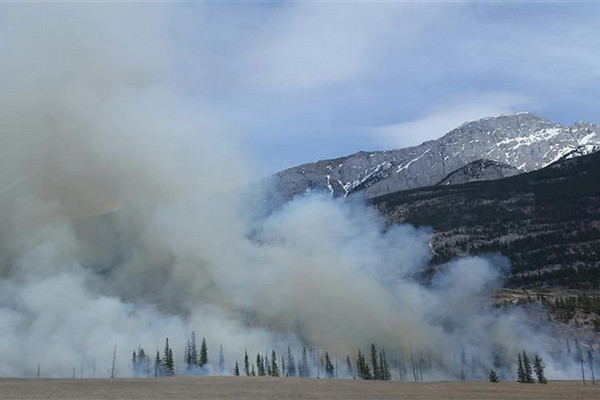
A fundamental issue in efforts to develop effective climate policy is "The Tragedy of the Horizon". The challenge is to identify the costs of climate change being experienced today when often they're assumed to be in the distant future. The scourge of B.C. Forest fires provides a means to do exactly that.
By John Richards, Professor Emeritus, School of Public Policy, Simon Fraser UniversityIntroduction
Download the JSGS Policy Paper
Download the Disussion Questions
In his 2021 book Value(s), Mark Carney used the phrase “Tragedy of the Horizon” as shorthand for the catastrophic impacts of future climate change. Business men, politicians, bankers – and most of us – accord little value to avoiding costs beyond the “horizon”. The net benefit of acting now to avoid consequences “beyond the horizon” is often perceived as negative: given a discount rate on the future, most Canadians perceive the present value of future benefits to be less than present value of mitigation costs.1
Another way to describe the problem is cognitive dissonance: most of us recognize two or more outcomes, but highlight only one. A perfect example of cognitive dissonance took place in the months leading up to the spring 2025 federal election. Opposition Leader Pierre Poilievre repeatedly used “axe the tax” as a rhetorical weapon against the federal government’s carbon tax. At a time when cost-of-living issues were at the top of the public agenda, Poilievre emphasized that the carbon tax on fossil fuels was regressive as share of family income. His rhetorical weapon ignored the external cost of using fossil fuels; implicitly, the carbon tax somewhat reduced greenhouse gas (GHG) emissions by making the polluter pay.
Once elected as prime minister, Carney acceded to public hostility toward the consumer carbon tax and “axed it”. Many modelers of Canadian GHGs have resigned to “axe the tax”, reassuring themselves that more effective mitigation policies – caps on estimated emissions from energy-intensive sectors such as manufacturing cement and refining Alberta’s oil sands.2 The caps constrain, somewhat, the external cost borne by the world’s population due to Canada’s high per capita GHG emissions, such as emissions from oil sands exploitation. At present, it appears that the majority of Canadians are unwilling to accept any significant mitigation policy – unless the costs to them are offset by a very large subsidy.
Adaptation and ear-marked taxes
Nearly all political leaders – President Donald Trump being the prime example of climate deniers – agree that burning fossil fuels is the major cause of drought and high temperatures, which are increasing forest fires across Canada, US, and forested regions elsewhere. The leaders know the cause, but they cannot persuade voters to do much about it. In other words, the majority of taxpayers don’t want to stretch their time horizon; nor do they want to balance high tax costs to realize effective future mitigation. British Columbia provides a good case.
Figure 1 illustrates the area (in thousand hectares) of forest burnt in BC between 2008 and 2025. The first observation is the dramatic increase in average annual forest area burnt: 930 thousand hectares 2017-25, relative to 165 thousand hectares 2008-16. It is hard to find factors other than increase in GHGs to explain the large difference. The second conclusion is a dramatic increase in variance of annual forest area burnt in the second period. To optimize over the next decades, much greater mitigation is required. (See Box).
Perhaps annual fire burnt area in BC will decline next decade. Optimism is highly doubtful. Extending the trend line is a better prediction of future events than is a return to the 2008-16 range. Persuading BC citizens is not easy!!

Source: Government of BC. 2025. Wildfire summer summary.
Note: 1 square kilometer = 100 hectares
The record annual area burnt to date is 2840 thousand hectares in 2023. In that year, the BC government estimates the direct cost of provincial fire suppression at $1.1 billion (Government of BC, 2024).3 A recent Canadian Forest Service study (Subedi, Bryan and Stennes, 2025) reported that the total direct and indirect costs of wildfire range from 1.5 to 20 times the cost of fire suppression. The authors do not estimate average ratio of indirect relative to direct costs and accrual of these costs – some to the provincial government; some to private owners of assets:
- Indirect costs accruing to the provincial government:
- Evacuating communities threatened by fires and housing people in hotels.
- Restoring public buildings (e.g., schools, libraries, community centres).
- Increasing health costs attributable to air pollution arising from fires.
- Indirect costs accruing to individuals:
- Restoring burnt homes, farm buildings and livestock.
- Forgone benefit of harvesting trees that have been burnt.
Based on the authors’ data, I assume a reasonable estimate of average annual 2017-25 total costs of BC forest fires to be direct costs for fire suppression plus indirect costs estimated at three times direct cost of forest fire suppression. A second assumption is half of indirect costs accrue to the provincial government. The sum of average direct cost plus half indirect costs accruing to the annual provincial government ranges between $506 and $1012 per family of four.4
There is a good case to require that BC households finance the direct plus indirect costs borne by the provincial government via an ear-marked tax – as opposed to an addition to the provincial debt. Introducing an ear-marked tax is an incentive for households to pay now, as opposed to paying later via an increasing provincial debt. Paying now implicitly extends the tragedy of the horizon, and minimizes cognitive dissonance. The tax could take several forms – for example, a supplementary personal income tax or a change in the provincial sales tax. Inevitably, the political temptation is to bury these forest fire costs as one more item increasing provincial debt.
Cognitive dissonance and two questions
The term cognitive dissonance might seem more suitable for discussions among psychologists. But it is on display in the current debate over development of an oil pipeline from Alberta oil sands to B.C.’s north coast. With Canada representing only 1.5 per cent of annual global emissions, Canadians have a more-or-less GHG free ride when refining and transporting oil sands. Doing so, we add substantial GHGs to the world atmosphere but distribute 98.5% of the GHGs to non-Canadians.
Alberta Premier Danielle SmithDanielle Smith hopes to increase the rate of oil sands export, via the northern BC coast. She is keen to get her pipeline, increase oil tankers, and thereby increase Alberta’s GDP. Firmly opposed to any such project is B.C. Premier David Eby, who intends to protect the environmentally sensitive B.C. coast from the threat of pollution from oil tanker disasters. At a much larger scale, Brazil faces an environmental disaster: enabling transition of tropical forest to agricultural use. It is doubtful that Smith intends to enter into a discussion of the environmental value of either the BC coast or Brazil’s tropical forest. In early October, Danielle Smith captured the Globe and Mail lead:
The Alberta government is taking the lead on an application for a major new oil pipeline to the BC coast in an attempt to break through several federal policies that Premier Danielle Smith has blamed for scaring away private investors.
The idea is to hammer out a proposal for a one million barrel a day bitumen pipeline. The proposal would be sent to Ottawa’s new Major Projects Office by May 2026 … Alberta does not want to be the financial backer but hopes the project will be deemed in the national interest … (Globe and Mail, 2025)
Two questions arise from their conflict, and both relate to cognitive dissonance.
Why was Poilievre’s “axe the tax” campaign popular with voters, so popular that Carney’s first decision as Prime Minister was to axe the tax? The short answer is cognitive dissonance, or what Carney terms the “tragedy of the horizon”: most Canadians are not willing to address both cost and benefit of a carbon tax on fossil fuels. Carney ignored the potential benefit that the “polluter pays” today for future environmental benefits. A similar event took place when former Prime Minister Brian Mulroney introduced the value added goods and services tax (GST). The GST tax simplified the federal sales tax and spread it more equitably among sectors than its predecessor. His government also introduced a negative income tax that addressed the regressive impact. Nonetheless, in the subsequent 1993 election his government was swept from office.
The second question is, who bears today’s cost of the environmental damage, whether forest fires or potential costs of damage from an oil spill on the BC coast? Are Danielle Smith and potential owners of a new pipeline discussing the 1989 consequences to the Alaskan coast of the Exxon Valdez oil spill of 240,000 barrels and willing to bear the costs if something similar should happen to the B.C. coast? If, as Carney said Canada is not for sale, there is no geographical region more important in defining Canada than the BC coast. Why should BC acquiesce to a pipeline when today Alberta’s provincial per capita GDP is currently the highest among Canada’s ten provinces?
Glossary
In climate change discussions, some jargon is inevitable.
- An externality is a transaction in which the purchaser pays only some of the costs arising from a purchase. (A car owner pays the price of filling his tank but does not pay the external cost arising from GHG exhaust when burning the car’s gasoline.)
- Mitigation policies are explicitly intended to reduce GHG emissions. A simple example is Trudeau’s introduction of an escalating carbon tax on gasoline (in BC, 17 cents per liter prior to its elimination). The logic is simple: polluters should pay. Faced with a higher gasoline price, people will hopefully drive smaller cars and/or electric vehicles.
- Adaptation is the cost of restoring the damage created by climate change.
- If Danielle Smith’s new pipeline is built, Alberta plays the role of free rider. By increasing world supply of petroleum, the GHGs from another pipeline will be shared around the world. Canada’s share of annual GHG emissions is about 1.5% of global emissions; hence Canadians accrue only 1.5% of whatever incremental damage accrues to the world increase in GHGs.
- Ear-marked tax is a tax label to publicize the allocation of the tax revenue raised. When the Saskatchewan government introduced its hospitalization insurance and improved post-depression schools in the 1940s, it raised a sales tax labeled “health and education tax”.
- Cognitive dissonance arises when people recognize two or more outcomes, but highlight only one.
Box 1
With permission, this brief includes a passage drawn from the article of Gray and colleagues.
Until recent years the magnitude of … wildfires has been neither widely known nor widely recognized, which perpetuated a “business as usual” attitude. Yet the profound impacts of fire on society, the environment, and the economy have begun to make the status quo unacceptable. Although decisions about how to proceed are admittedly difficult, complexity need not become an excuse for inaction. We may well be at a point where public awareness of the impacts of wildfires—including the health and visibility effects of smoke experienced in US, Canadian, and European cities over recent summers—combined with new information from ongoing studies by wildfire scientists is sufficient to help policy-makers and elected officials reconsider the preferred path forward with respect to wildfire management. Leaving aside many nuances, BC and other jurisdictions have two main options available to manage this crisis.
Option 1: Focus on response and recovery, with minor investment in mitigation
It is likely that costs will simply continue to rise as fires annually burn more area in the coming decades. … Direct costs (the active suppression of wildfires with firefighters, aircraft,heavy equipment, etc.) are expected to rise but not as steeply as indirect costs. Studies confirm that increased investment in suppression over the past century has proven to be ineffective in reducing area burned and total fire cost. It is realistic to assume that as more area burns, the indirect costs also will increase, as more [assets] are affected more severely by fire and smoke. Under option 1, the only potential downward pressures on this otherwise upward trend are mitigation investments (forest thinning, cultural and prescribed fires,etc.) and the availability of fuels to burn, both of which influence fire severity and subsequent fire impacts. Option 1 mirrors the current fire management choice in BC as well as many western US states and southern European countries. In the aftermath of a severe 2003 BC fire season and the subsequent 2004 government-commissioned Fire Storm Report, the provincial and federal governments spent ~$300 million on fuel treatments and other fire hazard mitigation measures (e.g., building code changes, new by-laws, public education, and various community initiatives). During the intervening two decades, however, both the area burned and direct fire costs have continued to increase substantially. Twenty-year longitudinal data clearly demonstrate that current investments in mitigation remain too low to result in any meaningful reduction in total fire impacts (10). In addition, an increasing percentage of future mitigation spending will need to be invested in the maintenance of already treated hectares and not on new areas, which will limit the total area treated over time. Eventually, with enough area burned and reburned, the area burned at high severity is likely to decrease, and with it some of the more financially damaging consequences of wildfires may be reduced. However, this “self-regulated landscape” condition at the scale of a province like BC imposes large costs on the environment, citizens (e.g., through effects of smoke on health and leisure), and the economy (e.g., through decreases in tourism and the forest base) and won’t be realized until far in the future. Further, the ongoing effects of climate change mean that many additional areas not now particularly at risk from wildfires will become more so in the years ahead.
Option 2: Response and recovery with substantially higher investment in mitigation
Option 2 is the more expensive strategy in the short term, which makes it more difficult to gain support from voters … This dual-purpose option—fire response plus ample proactive mitigation—requires ongoing suppression activities while damaging fires still occur. At the same time, governments would need to substantially scale up the investment in mitigation, linking strategic fuel treatments together to reduce the material available to burn and creating larger, landscape-scale units. Once a sufficiently large area has been treated, the costs of suppression and recovery should start to first flatten and then decrease. It’s important to note that once a decline in wildfire response costs is achieved, investments in mitigation will still have to be maintained despite the interannual variability in wildfire impacts and their associated costs—otherwise the gains will be lost as fuels reaccumulate and fire severity again increases. Research by fire scientists, paired with on-ground examples from recent wildfires, provides a roadmap for mitigation activities. In particular, small-scale (tens to hundreds of hectares in size) fuel treatments have shown high levels of effectiveness in reducing fire severity, even under high to extreme fire behavior conditions (i.e., dry fuels, high temperature, windy). A recent example involves fuel treatments that took place across 1300 hectares of forested land adjacent to the Indigenous community of aq’am and the Canadian Rockies International Airport in southeast BC. The area was treated with prescribed fire in April 2023 and tested by a high-severity wildfire in July 2023; the treated area stopped the wildfire, saving the airport (which is the nearest air tanker base) as well as dozens of homes. In this example, the investment in the mitigation work (thinning, prescribed burning) cost several million dollars. However, the avoided direct and indirect costs (loss of the airport, homes, and other structures; health and well-being impacts from evacuations and smoke; etc.), are measured in the tens of millions of dollars. To be effective at reducing fire risks and costs, the removal of woody fuels must occur at large scales, at times involving watersheds or landscapes that cover several hundred thousand or even millions of hectares, which in turn requires large and consistent investments over several decades. Although calculating the critical threshold for area treated is complex and will vary with fuel conditions, topography, and fire weather. Research on fire dynamics suggests that landscapes consisting of more than 40% of the area in vegetation widely spaced and slow to burn (e.g., mature aspen forests) rarely experience high-severity fire or extreme fire years.
JSGS Policy Brief continues below advertisement.

John Richards

John Richards is an emeritus economics professor at Simon Fraser University. He has published many C.D. Howe Institute social policy monographs. Recently, he has published education monographs in Canada and South Asia. This JSGS public policy brief owes much to the authors, Robert Gray, Robin Gregory, and Calvin Sandborn of a recent article estimating both direct and indirect costs of wildfires in British Columbia.
Endnotes
1 When a jargon in the glossary is first used, it is bolded.
2 Whether 17 cents per liter (the BC tax per liter of gasoline) had any effect on reducing gasoline consumption is admittedly dubious.
3 Karami and Walker (2025) include forest fires in their survey of climate-based disasters in Canada. They estimate total fire cost, 2000-23, is C$12 billion. The great majority of fire suppression cost has taken place since 2017.
4 The range of indirect costs noted in the article of Gray and colleagues is 1.5 – 20 times direct fire suppression costs assumed by the provincial government. The first assumption underlying my estimate of average direct costs 2017-25 is proration of the average 2017-25 forest area burnt relative to the provincial estimate of peak cost in 2023. The second assumption is that total indirect costs are in the range two times to six times direct costs – and that half indirect costs accrue to the provincial budget. The peak 2023 direct cost estimate is $1.1 billion (Government of BC, 2025). The average 2017-25 burnt forest is 930 thousand hectares. Prorating, the average 2017-25 direct cost is $360 million. The average 2017-25 annual direct provincial government cost per family is $253 (= $360 million / [5.7 million BC population / 4 people per family]). Total average indirect costs range between two times and six times total direct costs. My assumption is that half indirect costs accrue to government and that the range of total indirect costs is between average direct costs and three times total average direct costs. Given these assumptions, the range of total annual government liability is between $506 and $1012 per family.
References
Globe and Mail. (2025). Alberta to draw up proposal for new oil pipeline to BC. (2 October 2025).
Government of BC. (2024). Public accounts show BC put people first amid wildfires, global challenges. Accessed 20251007 at https://news.gov.bc.ca/releases/2024FIN0033-001352
Government of BC. (2025). Wildfire summer summary. Accessed 20251007 at https://www2.gov.bc.ca/gov/content/safety/wildfire-status/about-bcws/wildfire-history/wildfire-season-summary#previous-wildfire-season-summaries
Gray, Robert, Robin Gregory & Calvin Sandborn. (2025). Wildfire managements at a crossroads: Mitigation and prevention or response and recovery. Science (2 October 2025). See review of article, accessed 20251007 at https://vancouversun.com/news/scale-up-efforts-to-reduce-wildfire-risk-or-b-c-faces-dire-economic-consequences-study
Karami, M., T. Walker. (2025). Assessing Climate Preparedness: A comparative analysis of Canada’s provinces and municipalities. Canadian Public Policy., Vol.51, No.52
Please email your feedback or suggestions on the Policy Brief to the editor: dale.eisler@uregina.ca