


Regional Cooperation in Southwest Saskatchewan: A Case Study of the Town of Eastend, RM of White Valley, and RM of Arlington
Small towns and rural municipalities in Saskatchewan face significant fiscal sustainability challenges. A co-operative approach, where towns and surrounding RMs work together to share resources and infrastructure, can be a model for success.
By Jean-Marc Nadeau, Chief Executive Officer, Saskatchewan Urban Municipalities Association (SUMA) and Roxanne L. Korpan, Manager of Communications at SUMAIntroduction
Download the JSGS Policy Paper
Download the Disussion Questions
This Policy Paper explores how regional cooperation among municipalities at the local level can overcome the challenges of maintaining essential services and infrastructure that would otherwise be impossible to sustain. It focuses on the Town of Eastend and the Rural Municipalities of White Valley (No. 49) and Arlington (No. 79) in southwestern Saskatchewan.
The research is based on five semi-structured interviews with local elected officials and administrators: Don Lundberg, Reeve of RM of Arlington; James Leroy, Reeve of RM of White Valley; Alan Howard, Mayor of Town of Eastend; Shelley Rhodes, Administrator of RM of Arlington; and Tracey Schacher, Chief Administrative Officer of RM of White Valley and Town of Eastend. The analysis examines collaborative strategies for sharing services and co-financing projects to address common sustainability challenges in rural areas. The main question is how actors in resource-limited settings overcome structural and cultural barriers to work together on vital services—especially emergency response—while maintaining local identity.
The findings offer practical insights for municipalities seeking alternatives to amalgamation and for provincial policymakers aiming to create incentives that foster cooperation without compromising autonomy. The study highlights incremental, project-based collaboration as a practical approach for rural governance.
Background and Context
Eastend, a small town with around 600 residents and a limited commercial tax base, works closely with the Rural Municipalities of White Valley (No. 49) and Arlington (No. 79), both of which benefit from significant oil revenues. While Eastend has a relatively small population and revenue, it serves as an important community hub, providing essential services and infrastructure that support quality of life, such as recreational facilities, to the surrounding area. The resource imbalance between Eastend and the RMs of White Valley and Arlington, along with the recognition by municipal leaders that the town offers services benefiting residents of the RMs as well, has fostered a history of cross-boundary cooperation in firefighting, recreation, and health services. Notable initiatives include the construction of the Southwest Emergency Response Centre—a fire hall established through formal inter-municipal agreements and multi-party involvement—that acts as a central hub for shared emergency response. Eastend’s upgrade of its 1950s-era water treatment plant, a project costing approximately $8–$8.8 million, temporarily strained the town’s finances and required support from neighbouring rural municipalities. In 2025, the formation of the Southwest Regional Ambulance Group expanded collaboration to additional municipalities, restoring ambulance services in Eastend and enhancing staffing in the nearby Town of Shaunavon through bursaries, housing incentives, and coordinated advocacy with the Ministry of Health. Central to these efforts is a local political culture rooted in longstanding relationships, regular informal contact in community spaces like the rink, and strong social bonds that foster trust and reduce cooperation costs.
Theoretical Framework
Institutional Inertia in Saskatchewan’s Municipal Governance
This case study employs an integrated framework that combines historical institutionalism, status quo bias (Samuelson and Zeckhauser 1988), and veto player theory (Tsebelis 2002) to explain patterns of regional cooperation. Historical institutionalism helps to understand how institutions develop by suggesting that past decisions create dependencies that shape and limit future options (Kickert and Van der Meer 2011). In this view, institutions are not simply blank slates that can be easily changed; rather, they are shaped by historical contexts, where early policy choices trigger self-reinforcing cycles that are difficult to break. These paths can be interrupted by critical junctures—major events or crises that enable significant change—but often, the momentum of history persists (Thelen 1999).
An example from Saskatchewan’s municipal sector is the rigid separation between rural and urban municipalities, a structure established during the province's early settlement period to suit an agrarian society. This historical decision created a path dependency (Hall and Taylor 1996; Pierson 2000) that still influences local governance: Rural municipalities often have large industrial tax bases (such as the oil fields mentioned by the Reeves of White Valley and Arlington that generate substantial tax revenue for the RMs), while nearby urban municipalities, like the Town of Eastend, face high service demands but limited local taxes.
Despite economic shifts, the historical institutional framework endures, restricting the urban municipality’s capacity to fund infrastructure independently and prompting current leaders to navigate these entrenched roots through complex workarounds and joint arrangements rather than structural reform. Status quo bias is a tendency where individuals and groups prefer the current situation, often perceiving any change from the norm as risky or a loss rather than an opportunity. In public policy and institutional decision-making, this bias acts as a strong anchor, causing leaders to favour maintaining existing systems—even those that are inefficient—simply because they are familiar and outcomes are predictable. This resistance is often driven by loss aversion, where the psychological burden of the effort or disruption needed to change feels greater than the potential gains. As a result, institutions can fall victim to inertia; for example, a local government might reject a modern, cost-efficient shared services agreement in favour of a struggling independent model, or a department might cling to outdated paper-based filing systems. They do this not because the new solutions are flawed, but because the transition challenges the comfort of “how we’ve always done it.”
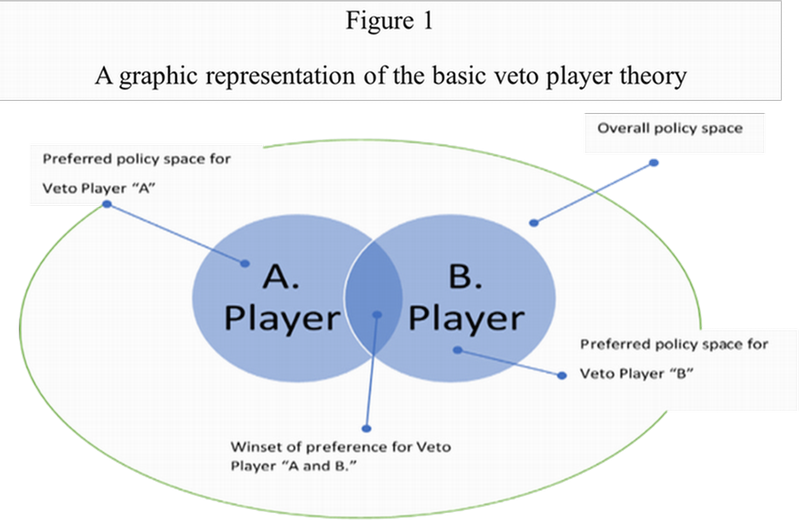
Additionally, the existence of multiple veto players—the town and RM leaders—restricts policy change to situations where their preferences overlap, favouring coalition-compatible initiatives over unilateral restructuring. George Tsebelis’ Veto Player Theory (2002) is a key concept in comparative politics explaining why some systems experience high policy stability and slow change. The theory states that the number and ideological distance of veto players—actors whose agreement is necessary to alter the status quo—determine the likelihood of policy shifts. Veto players can be institutional (e.g., legislative assembly or the premier) or partisan (e.g., coalition partners, such as the Saskatchewan Urban Municipalities Association [SUMA]). The more veto players there are and the greater their ideological differences, the smaller the set of policies they agree on, making change more difficult. In summary, more veto players lead to increased policy stability, while fewer or ideologically aligned veto players facilitate reform. This framework, shown in Figure 1, is widely used to analyze legislative gridlock, coalition governance, and incremental policymaking.
Case Description
Shared services & projects
Regional cooperation among Eastend, White Valley, and Arlington is evident through shared service initiatives that improve community sustainability. Fire protection is managed by a district fire department operating under a formal cost-sharing agreement that links contributions to coverage and usage. Recreation facilities such as the swimming pool, rink, and community hall in Eastend benefit from joint investments and annual grants, while Arlington also supports Shaunavon to encourage cross-community participation. Water infrastructure upgrades, including Eastend’s modernized water plant, have significantly enhanced water quality and reliability, with White Valley contributing to these benefits annually. Health services are strengthened by a multi-RM committee that allocates $20,000 bursaries, offers EMR training and support, provides free housing and tax coverage to attract and retain staff, and works to install a digital X-ray system at the local health centre to reduce residents’ travel. Governance arrangements are organised on a project-by-project basis, formalized through specific agreements or bylaws—such as those for the fire hall and ambulance service—rather than through a single regional compact. Resource differences influence these initiatives: White Valley and Arlington’s oil revenues boost their financial capacity to support town amenities and regional services, while Eastend has a smaller, more limited budget following the financing of its water plant.
Analysis and Discussion
The Eastend–White Valley–Arlington case demonstrates how rural municipalities often expand their cooperation gradually rather than through large mergers.
First, initial small steps towards collaboration develop as a process influenced by previous actions (Pierson 2000), with stakeholders creating service-sharing agreements and joint funding within existing structures. These municipalities collaborate on individual projects to address shared needs, each operating under different governance and resource-sharing arrangements. Mayor Alan Howard highlights ongoing cooperation beyond major initiatives, noting that local RMs contribute in-kind support such as grader work and mowing the grass at the regional airport’s runway. This cautious approach aligns with historical institutionalism: build on current structures, avoid reforms that threaten local identity, and achieve tangible results like faster emergency responses, improved recreation facilities, and upgraded water systems.
Second, the bias towards maintaining the status quo is addressed by framing collaboration as a way to reduce perceived losses. Interviewees highlight clear communication, trust-building, and identity preservation as key priorities that facilitate successful collaboration. Administrator Shelley Rhodes stressed how municipal councillors and administrators play a significant role in creating an environment where regional cooperation is valued and prioritised. Open, regular dialogue in formal venues like council meetings and informal settings such as the local rink help strengthen trust and keep partners accessible and responsive, as Reeve James Leroy and Mayor Howard shared. Reeve Leroy and White Valley CAO Tracey Schacher explained that clear communication also helps municipalities understand their own priorities, their neighbours’ priorities, and the complementary strengths of each, which is vital for finding common ground while maintaining local identity. Each interviewee recognised the existing bonds between neighbouring municipalities, as residents rely on shared services, schools, and amenities centred in the Town of Eastend. This awareness encourages mutual support, with municipal leaders knowing they must collaborate for each community to stay viable. To reduce perceived losses, this collaboration uses cost-sharing models that align contributions with usage and fiscal capacity—RMs benefiting from resource revenues bear more capital costs, while the Town of Eastend handles operations. Likewise, workforce incentives like bursaries and housing frame staffing changes as community benefits rather than upheaval. Each municipality’s assets—including financial, human resources, infrastructure, and housing—are viewed as enhancing collective capacity.
Third, veto player constraints are managed through projects that align with coalitions. Although the interviews do not explicitly mention veto player theory, the principles are clear through the collaborative efforts and decisions made by municipal leaders. This theory proposes that policy change becomes more challenging as the number of actors who can block it—called “veto players”—increases. Support for regional collaborations, such as those Administrator Rhodes mentioned for maintaining essential services—specifically for the regional ambulance service based in the Town of Eastend—can also be hindered by any single municipality. This is evident in the effort to restore ambulance services in this region through the Southwest Regional Ambulance Committee, which includes six different municipalities—Eastend, White Valley, and Arlington, along with the Town of Shaunavon and the RMs of Grassy Creek No. 78 and Bone Creek No. 108—each acting as a potential veto player whose approval is required.
Likewise, the joint funding initiative mentioned by Mayor Howard, which pools resources from the Town of Eastend and the rural municipalities of Arlington and White Valley, demanded careful negotiation to align each government’s interests. This grant program, funded by all three local governments through a formal agreement, supports community-based organisations in the region; for example, Mayor Howard explained that Memorial Hall had applied for funding to modernise its HVAC system. Even policy drift, such as the ineffective provincial grants noted by Reeve Don Lundberg, hints at distant, influential veto players at a higher level of government whose inaction or resistance can impede major policy shifts and uphold the status quo. These examples demonstrate that achieving policy change among multiple stakeholders is a complex process that requires building consensus across diverse interests—an idea central to veto player theory. Figure 2 illustrates how, in this case, the three municipalities collaborate, as evidenced by the veto players’ unanimous agreement. Essentially, public policy in the southwest can be implemented more smoothly because the veto players share a strong consensus.
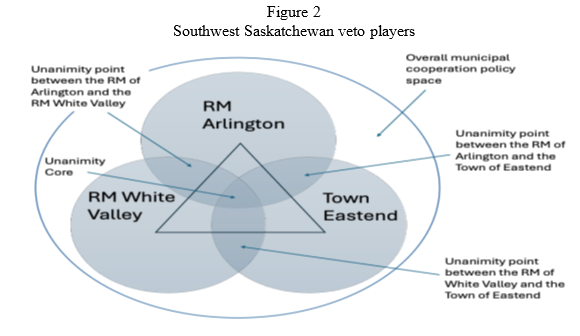
A GRAPHIC REPRESENTATION OF THE SOUTH SK REGIONAL COOPERATION VETO PLAYERS
Fourth, fiscal pragmatism and administrative learning enhance collaboration. Reeve Lundberg, for example, noted that Arlington has opted out of certain provincial grants for road construction because the grant program requires costly engineering drawings, illustrating a learning-by-doing approach. Meanwhile, experienced administrators and informal coordination within community spaces help preserve institutional memory and reduce transaction costs.
Lastly, community sustainability is supported through shared amenities and workforce pipelines. Recreation grants keep youth engaged locally, ambulance staffing incentives including bursaries and subsidized housing, and inter-municipal committees ensure reliable emergency services. Investments in digital diagnostics reduce travel burdens for seniors. These people-centred strategies complement infrastructure improvements, strengthening rural viability without boundary changes—demonstrating that incremental, project-based regionalism provides a politically viable path for Saskatchewan’s municipal sector.
Implications and Recommendations
For municipalities, an initial step toward effective regional cooperation could be to concentrate on essential services such as fire protection and ambulance coverage, where shared risks and evident benefits justify collaboration. These arrangements should be formalized through project-specific bylaws and agreements that align contributions with coverage and usage, ensuring fairness and transparency. To build trust and momentum, municipalities should secure small wins—like recreation grants and shared diagnostic services—before addressing more complex assets, such as roads and bridges. Creating arrangements with minimal perceived loss is vital: preserve local identity, ensure transparent cost sharing, and maintain regular communication to counteract the bias toward preserving the status quo. Long-term sustainability also relies on investing in workforce pipelines, including bursaries, housing incentives, and career fairs with return-of-service agreements for EMTs and EMRs, while harmonizing these incentives across municipalities to improve recruitment and retention.
For provincial policymakers, the focus should be on creating conditions that encourage cooperation. Targeted matching funds that reward multi-municipal projects—such as ambulance staffing and shared diagnostic initiatives—can broaden options while lowering compliance costs. Likewise, streamlining grant processes or offering alternative compliance pathways for municipal road projects can reduce administrative burdens and improve local implementation efficiency. Policymakers should also promote roundtables for urban–rural pairs facing strained relations, concentrating on practical, jointly developed projects rather than structural reforms that often meet resistance. Finally, communication tools, including templates and dashboards, can assist municipalities in keeping citizens informed about collaborative outcomes, increasing public satisfaction and strengthening the political resilience of regional initiatives.
Clearly, the role of regional cooperation is vital for supporting municipal governance, particularly in areas with small populations, limited tax bases, and increasing service demands. By pooling resources and sharing risks, municipalities can sustain essential services—such as emergency response, infrastructure, and recreation—that might be financially or operationally unfeasible independently. Collaborative efforts also enhance fiscal efficiency by reducing service overlap, achieving economies of scale, and aligning costs with actual usage and fiscal capacity. Generally, this leads to practical cost-sharing models where municipalities contribute based on their strengths while consolidating administration to streamline service delivery.
As this research has demonstrated, regional cooperation offers a politically viable alternative to municipal amalgamation. While amalgamation might diminish local identity and democratic representation, cooperative agreements allow municipalities to retain legal independence while collaborating on specific services. This gradual, project-based method also helps to overcome institutional inertia and resistance to change by building on existing governance structures rather than implementing drastic reforms. Small, successful projects can make collaboration normal over time, gradually reducing opposition to change.
Between the Town of Eastend and the rural municipalities mentioned in this case, there has been notable regional cooperation despite the lack of formal agreements to support the relationship or projects. Elected and administrative officials have learned to collaborate and recognize the importance of regional cooperation. That said, there are other examples in the sector where formal agreements have supported municipal cooperation, potentially leading to more stable and predictable outcomes for these partnerships. Either way, it is clear that regional cooperation remains essential for the future sustainability of municipalities.
Conclusion
The Eastend–White Valley–Arlington experience demonstrates how incremental, project-based regionalism can surpass institutional inertia without threatening local identity. Leaders foster trust, share costs efficiently, and utilize people-centred incentives to deliver essential services and amenities, thereby enhancing community sustainability in a resource-limited environment. For Saskatchewan’s municipal sector, coalition-compatible cooperation—rather than amalgamation—appears to be the politically feasible approach to achieve better outcomes, aligning with principles of historical institutionalism, bias towards maintaining the status quo, and veto player constraints.
JSGS Policy Brief continues below advertisement.


Appendix A: References
Interviews:
-
- Mayor Alan Howard, Town of Eastend (Sep 24, 2025).
- James Leroy, Reeve, RM of White Valley (Dec 1, 2025).
- Shelley Rhodes, Administrator/CAO, RM of Arlington No. 79 (Nov 29, 2025).
- Don Lundberg, Reeve, RM of Arlington No. 79 (Sep 24, 2025).
- Tracey Schacher, CAO, Town of Eastend & RM of White Valley (Sep 24, 2025).
Works Cited
Hall, P. A., & Taylor, R. C. R. (1996). Political Science and the Three New Institutionalisms. Political Studies, 44(5), 936–957.
Kickert, W. J. M., & Van der Meer, F.-B. (2011). Small, Slow, and Gradual Reform: What can Historical Institutionalism Teach us? International Journal of Public Administration, 34(8), 475–485.
Pierson, P. (2000). Increasing Returns, Path Dependence, and the Study of Politics. The American Political Science Review, 94(2), 251–267.
Samuelson, W., & Zeckhauser, R. (1988). Status quo bias in decision-making. Journal of Risk and Uncertainty, 1(1), 7–59. https://doi.org/10.1007/BF00055564
Thelen, K. (1999). Historical Institutionalism In Comparative Politics. Annual Review of Political Science, 2(1), 369–404.
Tsebelis, G. (2002). Veto Players: How Political Institutions Work. Princeton University Press.
Jean-Marc Nadeau

Jean-Marc Nadeau is a retired Royal Canadian Mounted Police commissioned officer. In 2013, following a 23-year career in law enforcement, Jean-Marc embarked on a career in the municipal sector. As SUMA's CEO, Jean-Marc is responsible for leading and managing the organization according to the strategic direction set by the Board of Directors. He is passionate about serving the interests of Saskatchewan's urban municipalities and advancing their collective vision. Jean-Marc holds a PhD from Johnson Shoyama Graduate School of Public Policy (JSGS). His research interests include historical institutionalism in the public sector.
Roxanne Korpan

Roxanne Korpan is a communications professional, researcher, writer, and artist. She currently serves as Manager of Communications at the Saskatchewan Urban Municipalities Association (SUMA). Her interdisciplinary research and professional experience span public policy, municipal governance, arts and culture, museums and heritage, social services, Indigenous relations, Canadian history, and equity, diversity, inclusion, and reconciliation. Roxanne holds a PhD in the humanities from the University of Toronto.