

Who Owns Saskatchewan’s Farmland? An updated analysis
Farmland remains one of Saskatchewan's most important and most valuable natural endowments. How it is managed raises important policy issues about the concentration of ownership, by whom, for what purposes, and its effects on the sector.
By André Magnan, Darrin Qualman, Emily Duncan and Annette Aurélie DesmaraisIntroduction
Download the JSGS Policy Brief
Download the Disussion Questions
Agriculture remains a critical economic driver in Saskatchewan, with its 34,000 farms earning $21.5 billion in revenue in 20241 and producing 41.9 million tonnes of crops in 20252. As the foundation for agricultural production and a crucial form of financial security for farm families, farmland is one of the province’s most valuable natural endowments. In the past 20 years, farmland values have increased dramatically, with an average annual increase of 11% from 2005 to 20243.
Given its importance to the agricultural sector, it is no surprise that there is ongoing public interest in farmland. In Fall 2024, the provincial Auditor General’s report raised concerns about how residency requirements are verified for farmland purchases. This touched off public debates about ‘foreign ownership’ and the Farmland Security Board’s ability to enforce Canadian residency requirements. During the Fall 2025 sitting of the provincial legislature, the opposition accused the government of failing to stop illegal foreign acquisitions and demanded a public inquiry4. Beyond questions around ownership rules, changing patterns of farmland ownership raise concerns about farm consolidation and young farmers’ lack of access to farmland due to rising prices.
This Policy Brief seeks to provide reliable facts on recent farmland ownership changes, including the extent of investor ownership and growing concentration. We present our analysis of Saskatchewan land titles records, providing some longitudinal trends that can inform a public policy debate grounded in evidence. We track changes in investor ownership patterns and show how farmland concentration is accelerating, often driven by large farming entities. We found no evidence of non-Canadian ownership of farmland among investors or other large-scale owners.
Understanding farmland ownership
In Saskatchewan, land ownership is captured in public land titles records managed by the Information Services Corporation (ISC). In 2014, we pioneered a methodology for analyzing the land titles database to get a snapshot of farmland ownership trends at a point in time5. In this brief, we present the results of our latest analysis, using data from December 2023. We obtained the complete set of land titles records for all Saskatchewan Rural Municipalities (RMs).
Our analysis focuses on private farmland owners, including farmers, farming corporations, and farmland investors. We excluded land owned by the Crown, Crown Corporations and other public utilities, religious colonies, and conservation organizations, and we excluded very small parcels (less than 10 acres). We calculated the cumulative holdings of private farmland owners to determine the top investor and non-investor owners and their collective holdings.
For our purposes, investors are defined as those who acquire farmland primarily as a financial asset, that is for the purpose of realizing investment returns. Typically, investors acquire a portfolio of farmland across several RMs and rent it out to producers. We identified investors through the Corporate Registry and internet searches and included in our analysis only those with holdings of 3,000 acres or more. Well-known investors include wealthy individuals such as Robert Andjelic (Andjelic Land Inc.) and institutional investors structured as limited partnerships or farmland funds (e.g., Veripath/Omigience and Avenue Living). Other large-scale private owners are typically farmers, including both family-farms (with most labour and capital provided by a farming family) and corporate mega-farms (defined for our purposes as farms managing over 30,000 acres). We restricted our analysis to non-investor owners holding at least 10,000 acres of farmland, which we refer to as large-scale private landowners.
Stabilization of investor ownership
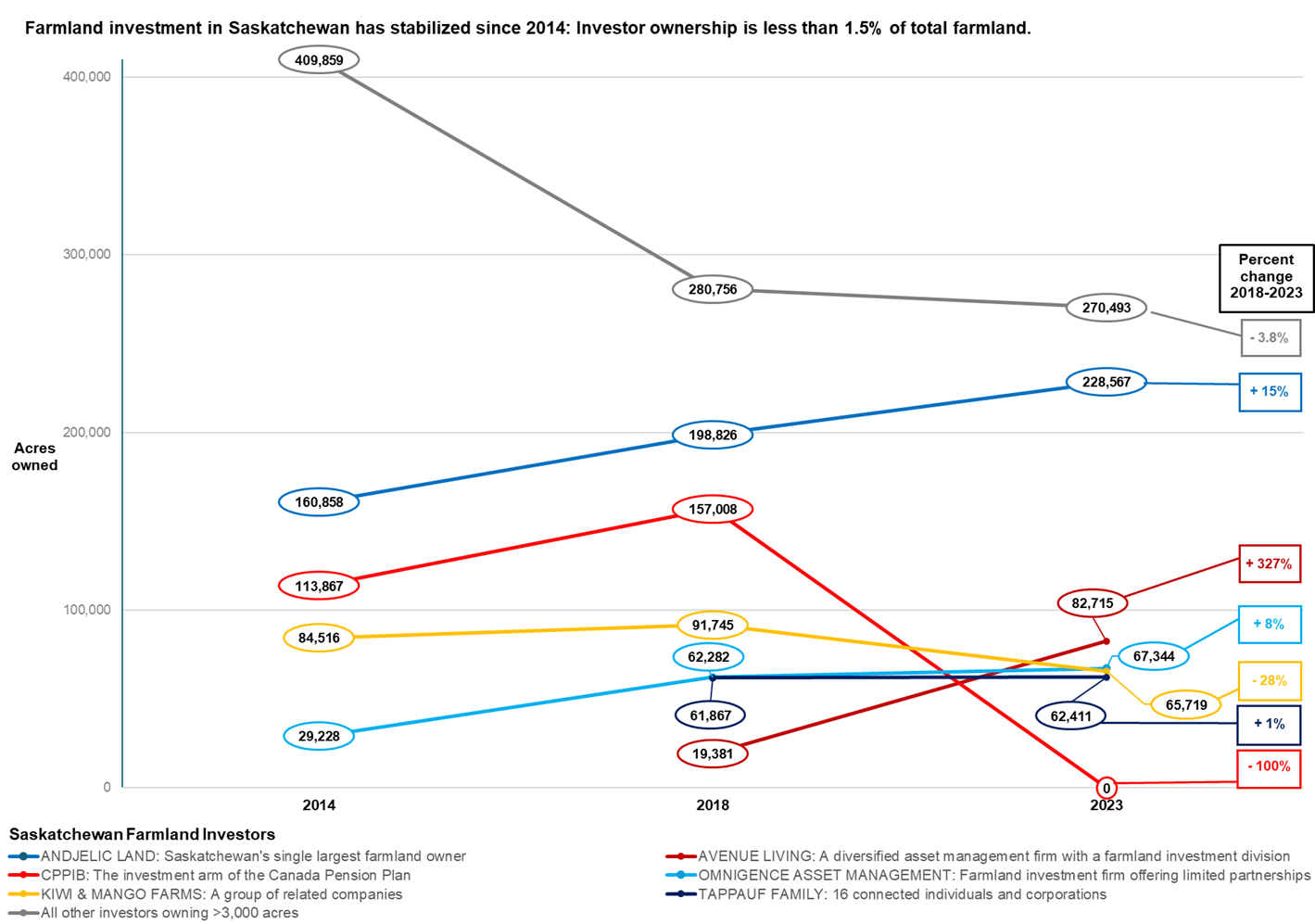
As Figure 1 shows, investor ownership increased between 2014 and 2018 but declined between 2018 and 2023. These patterns reflect some notable entries and exits from the farmland market. The Canadian Pension Plan Investment Board (CPPIB), which acquired over 115,000 acres in a deal in 2014 and reached over 157,000 acres by 2018, had completely divested from Saskatchewan farmland by 2023. While a change in provincial legislation in 2015 prohibited pension plans and certain investment trusts from acquiring land, it did not require CPPIB to divest its assets6. However, the CPPIB decided to divest in 20177, reporting in 2022 that it had completed the liquidation of its farmland portfolio, netting proceeds of $390 million8.
Avenue Living, a commercial real estate investment company, has aggressively acquired farmland in the last few years, becoming the second largest investor owner by 2023. Its primary business is multi-family residential real estate, but it now operates a farmland investment division with $146.5 million under management. Other players such as Omnigience (previously Veripath) are well established, acquiring Saskatchewan farmland since 2007 in a series of limited partnerships, some of which have exited. The overall level of investor ownership seems to have stabilized at less than 1.5%9 of total Saskatchewan farmland.
Figure 1 – Farmland investors in Saskatchewan
Source: Adapted from Information Services Corporation, Ownership Data, Dec. 31, 2023.
Growth in non-investor farmland holdings
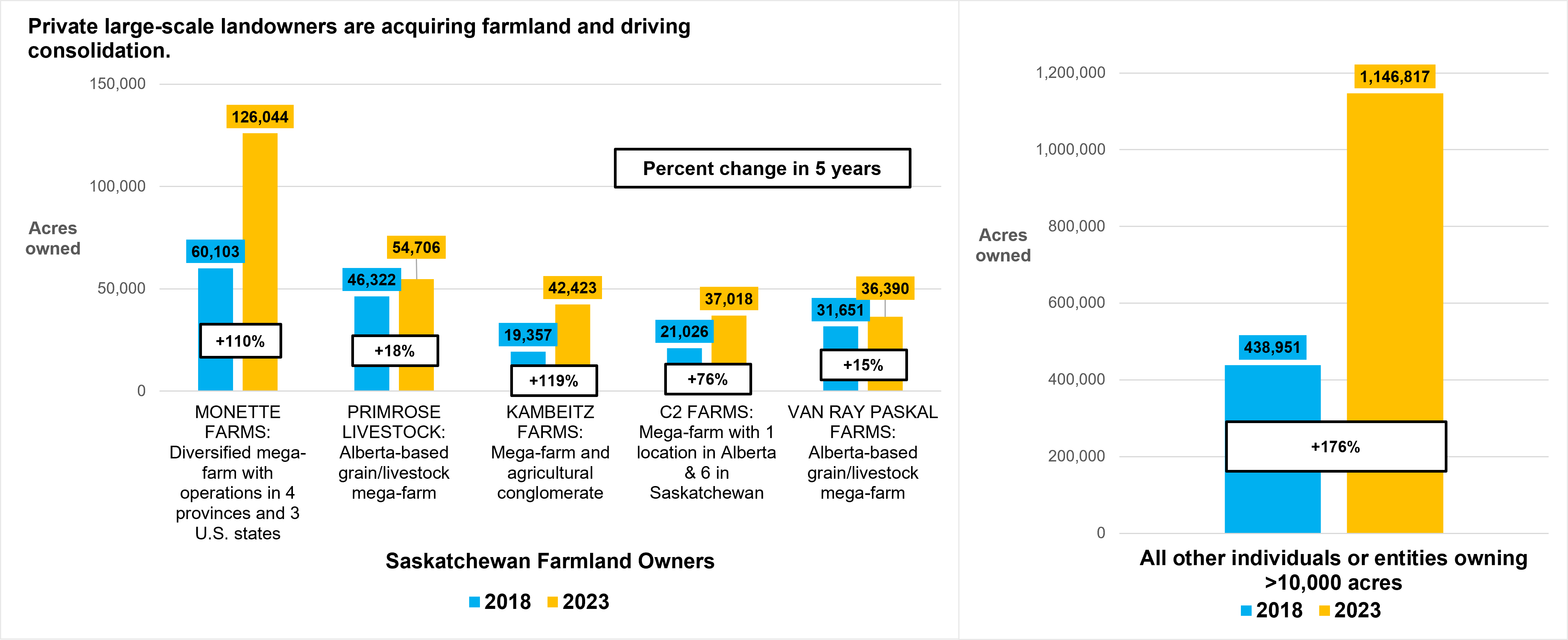
We report on other large-scale private landowners in Figure 2. This group includes farmers, farming corporations, and mega-farms owning over 10,000 acres each. In 2018, there were 36 large farmland owners, owning a cumulative 601,448 acres. By 2023, we identified 84 large farmland owners who together own over 1.44 million acres (or 2.4% of all Saskatchewan farmland). The amount of land owned by these large-scale private owners increased by 140% over the five years in question.
Among the largest owners are mega-farms like Monette Farms, which now has operations in Saskatchewan, Alberta, Manitoba, B.C., Arizona, and North Dakota. Between 2018 and 2023, it more than doubled its farmland ownership in Saskatchewan. It has livestock, grains, seed, and fruit and vegetable divisions. Other mega-farms include Primrose Livestock and Kambeitz Farms. Some of the mega-farms have seen impressive growth in the last several years. The figures reported here represent only the farmland owned by these corporations, not their total land base, which typically also includes rented land and can be much larger when combining owned and rented land.
These large-scale owners have been rapidly acquiring farmland in the last few years. This trend reflects both the expansion orientation of family-farms (many of which now exceed 10,000 acres) and the ambitious growth strategies of a small number of mega-farms.
Table 2 – Other large-scale owners of Saskatchewan farmland
Source: Adapted from Information Services Corporation, Ownership Data, Dec. 31, 2023.
Policy implications
Investor ownership of farmland and growing land concentration have raised concerns among some in the agricultural industry and the wider public. Amid intense competition for farmland and rising prices, farmers may question the fairness of having to compete against investors or mega-farms for land. These effects are likely felt more keenly in regions where there is greater concentration of ownership. Mega-farms and investors may have competitive advantages over family-farms, including better access to capital, better access to market information, and economies of scale.
There is also growing concern that farmland prices have become detached from the income generating value of land. In Saskatchewan, farmland affordability has deteriorated in recent years as farmland prices have increased faster than the income-generating potential of the land. Farm Credit Canada reports that in 2024, Saskatchewan’s farmland affordability index was at its highest level (i.e., least affordable) since 1990, reflecting higher payments for newly acquired land and lower farm receipts10. In a similar vein, analysis has shown that since 2020 renting farmland provided greater cash flow than buying land but purchasing led to larger economic gains over the medium term through capital appreciation11. This may suggest that enthusiasm for buying land has less to do with projected income from farming and more to do with expected capital gains. These conditions could widen land inequality, as younger farmers or those with greater financial pressures are compelled to rent rather than purchase land.
Addressing access to land and growing concentration could include further restrictions on farmland ownership like prohibiting out-of-province buyers or certain classes of investors or placing a cap on the maximum number of acres any given entity can own. Prince Edward Island, for example, caps landownership for individuals and corporations under its Lands Protection Act. If a similar cap were considered in Saskatchewan, it would have to consider the nature of different production systems (grains, livestock, mixed) and land types (cropland versus pasture) and would need farmers’ support.
Beyond capping landownership, another policy lever could be reforming farm support programs. From 2020-24, total net payouts to farmers in Saskatchewan were $1.29 billion per year12, representing the annual average taxpayer transfers to farmers. Net payouts for Crop Insurance (the vast majority of which go to crop farmers) were on average $24.27/acre. Combined supports from AgriStability, AgriInvest, and AgriRecovery were $4.69/acre, if we assume that program payments are distributed in proportion to the number of crop farms (71% of farms) to livestock farms (29%). Total public support for crop farms is therefore estimated to be $28.96/acre on average. For a 10,000 acre farm, this translates to $289,600 per year, whereas a 100,000 acre mega-farm would receive, on average, $2.9 million per year. Programs payouts for AgriStability, an income stabilization program, are normally capped at $3 million per year, though this was temporarily raised to $6 million in 2025, to assist farmers with trade disruptions13. Crop insurance, by contrast, is not capped (either in acres covered or maximum payouts), meaning certain mega-farms could be receiving payments over $10 million.
Farm support programs were created decades ago with a policy goal of preserving family-farms and providing greater stability for a notoriously volatile industry. As early as 2012, the National Farmers Union proposed lowering caps on farm program payouts14. As farm consolidation continues, there is a strong case to be made that very large players do not need public subsidies in the form of crop insurance or other farm supports on par with family-farms. Rather, these players should be expected to internalize the costs of risk management. A cap on crop insurance, in particular, would help slow the trend towards farmland consolidation. The cap could apply to acres covered, total liability, or payouts, depending on the design.
Conclusion
In early 2026, there are some signs that the Saskatchewan farmland market is shifting. Monette Farms has listed 10 farms for sale in Saskatchewan, representing up to 129,000 acres (likely its entire portfolio)15. This is in addition to listings in Manitoba (49,000 acres), Montana (54,000 acres), and British Columbia (45,000)16 suggesting the mega-farm is undergoing a major restructuring and possible liquidation of its farmland holdings. Other farmland observers, including real estate agents and investors, have indicated that they expect to see a softening of the farmland market. If prices decline, this might bring some relief to those trying to enter the market or expand their operations. It’s unclear that this would change the long-running trajectory of increasing ownership concentration. Policymakers, farmers, and other stakeholders should consider ways of slowing or reversing ownership concentration to ensure that farmland remains in the hands of the many whose livelihoods and economic security depend on the land.
JSGS Policy Brief continues below advertisement.

Bibliography
1 Source : Statistics Canada Table 32-10-0136-01 Farm operating revenues and expenses, annual. DOI: https://doi.org/10.25318/3210013601-eng; Statistics Canada. Table 32-10-0153-01 Land use, Census of Agriculture historical data. DOI: https://doi.org/10.25318/3210015301-eng
2 Government of Saskatchewan. 2025. Saskatchewan Crop Production Hits Record High in 2025. https://www.saskatchewan.ca/government/news-and-media/2025/december/19/saskatchewan-crop-production-hits-record-high-in-2025
3 Farm Credit Canada. 2025. Historic FCC Farmland Values Report. https://www.fcc-fac.ca/en/reports/2024-historic-farmland-values-report
5 Desmarais, A. A., Qualman, D., Magnan, A., & Wiebe, N. 2015. Who should own land in Saskatchewan?https://www.schoolofpublicpolicy.sk.ca/research-ideas/publications-and-policy-insight/policy-brief/farmland-ownership-in-SK.php
Magnan, A. 2017. Who is buying the farm?: Farmland investment patterns in Saskatchewan, 2003-14. Canadian Centre for Policy Alternatives. https://www.policyalternatives.ca/wp-content/uploads/attachments/Who_is_Buying_the_Farm_SK_2003-14.pdf
6 An amendment to the regulations was passed in Oct. 2025, eliminating the loophole that had allowed CPPIB to continue holding farmland: https://www.saskatchewan.ca/government/news-and-media/2025/october/14/the-saskatchewan-farm-security-regulation-amendments-strengthen-ability-to-enforce-act
7 https://globalaginvesting.com/canadas-cppib-signals-retreat-farmland-may-sell-portfolio/
9 Authors’ calculation, based on a total of 60.3 million acres of Saskatchewan farm area reported in the 2021 Census of Agriculture: https://www150.statcan.gc.ca/n1/pub/96-325-x/2021001/article/00008-eng.htm
10 Source: Farm Credit Canada. 2025. Canadian farmland affordability trending down. March 26. https://www.fcc-fac.ca/en/knowledge/economics/canadian-farmland-affordability
11 Farm Credit Corporation of Canada. 2025. 2024 Farmland rental rates – Renting or purchasing depends on many factors. April 16. https://www.fcc-fac.ca/en/knowledge/economics/2024-farmland-rental-rates
12 Source: Statistics Canada. Table 32-10-0106-01 Direct payments to agriculture producers (x 1,000). DOI: https://doi.org/10.25318/3210010601-eng
13 Source: Government of Saskatchewan. 2025. Governments of Canada and Saskatchewan Announce Changes to 2025 AgriStability Program. July 21. https://www.saskatchewan.ca/government/news-and-media/2025/july/21/governments-of-canada-and-saskatchewan-announce-changes-to-2025-agristability-program
14 National Farmers Union. 2012. Business Risk Management Programs under Growing Forward 2. August 21. https://www.nfu.ca/policy/business-risk-management-programs-under-growing-forward-2/
15 Hursh, Kevin. 2026. Angjelic, Monette two big farmland players in Saskatchewan. Western Producer. February 18. https://www.producer.com/opinion/andjelic-monette-two-big-farmland-players-in-saskatchewan/?__cf_chl_tk=oolnsDaeaYSPDA2oy8W7dimI9rUT0F7jOzriJJC8X7I-1771863868-1.0.1.1-eurKzmL1n1ydhqa1FtoMmEcvX7MYUcJWQJD.U1X0wJo
16 Briere, Karen. 2026.Monette Farms selling more land. Western Producer. January 20. https://www.producer.com/news/monette-farms-selling-more-land/
André Magnan

Darrin Qualman

Darrin Qualman is a former farmer and, until 2025, a lead staffperson with Canada’s National Farmers Union. He is the author of the book Civilization Critical: Energy, Food, Nature, and the Future. And he has academic degrees in History, Political Studies, and Biology.
Emily Duncan

Dr. Emily Duncan is a Banting Postdoctoral Fellow in the Department of Sociology and Social Studies at the University of Regina. She is a food systems scholar and her research aims to connect trends of agricultural technologies, environmental management, changing patterns of farmland ownership, and impacts on rural communities.
Annette Aurélie Desmarais

Annette Aurélie Desmarais is Professor Emerita at the University of Manitoba, Adjunct Professor at the University of Saskatchewan’s School of Environment and Sustainability, and President of the National Farmers Foundation. After conducting research in various countries, she led a major research project on changing land tenure patterns on the Canadian Prairies (2017-2021).